Introduction to Industry 4.0
Industry 4.0, often abbreviated as the Fourth Industrial Revolution or 4IR, represents a paradigm shift in manufacturing and industrial processes driven by the integration of advanced digital technologies. Coined in the early 2010s, it builds on previous industrial revolutions—mechanization in Industry 1.0, mass production in 2.0, and automation in 3.0—by emphasizing connectivity, data-driven insights, and intelligent systems. At its core, Industry 4.0 leverages cyber-physical systems (CPS), where physical machinery interacts seamlessly with digital networks, enabling real-time decision-making, enhanced productivity, and unprecedented flexibility.
Key pillars of Industry 4.0 include the Internet of Things (IoT) for device connectivity, big data analytics for processing vast amounts of information, artificial intelligence (AI) and machine learning for predictive capabilities, cloud computing for scalable storage and collaboration, and additive manufacturing (like 3D printing) for rapid prototyping. Unlike its predecessors, this revolution isn’t just about automating tasks; it’s about creating “smart factories” where machines communicate autonomously, optimize operations, and adapt to changes without human intervention. As of 2025, with the rise of Industry 5.0 focusing on human-machine collaboration, Industry 4.0 remains foundational, particularly in sectors like manufacturing and engineering.
The Evolution of CNC Machines in the Industry 4.0 Era
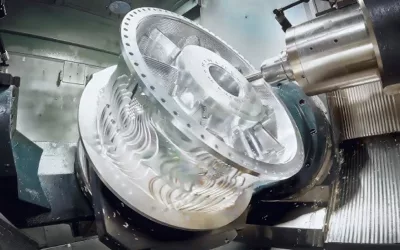
Computer Numerical Control (CNC) machines, which have been staples in precision manufacturing since the mid-20th century, are undergoing a profound transformation under Industry 4.0. Traditionally, CNC systems relied on programmed instructions to control tools for cutting, milling, and shaping materials. Now, integrated with Industry 4.0 technologies, these machines are evolving into intelligent, connected devices that form the backbone of smart manufacturing.
One major impact is enhanced automation and connectivity. IoT sensors embedded in CNC machines allow for real-time monitoring of performance metrics like temperature, vibration, and tool wear. This data feeds into cloud-based platforms, enabling predictive maintenance—where potential failures are anticipated and addressed before they cause downtime, reducing costs by up to 20-30% in some cases. AI algorithms further optimize machining processes by analyzing historical data to adjust parameters dynamically, improving efficiency and part quality.
For instance, in a smart factory setup, CNC machines can integrate with robotics for seamless workflows, where robots handle material loading/unloading while the CNC performs precision tasks. This synergy not only boosts productivity but also supports mass customization—producing small batches of tailored products without sacrificing speed or cost-effectiveness. Advances like augmented reality (AR) overlays on CNC interfaces allow operators to visualize simulations and troubleshoot issues virtually, minimizing errors. Overall, Industry 4.0 elevates CNC from isolated tools to interconnected nodes in a digital ecosystem, driving a 15-25% increase in operational efficiency across industries like aerospace, automotive, and medical devices.
Broader Implications for Engineering Disciplines
Industry 4.0’s ripple effects extend far beyond CNC machines, reshaping the entire field of engineering, particularly mechanical engineering. Engineers are now tasked with designing systems that are not only mechanically sound but also digitally integrated, sustainable, and adaptable. In product design, tools like digital twins—virtual replicas of physical assets—enable simulation and testing in virtual environments, accelerating development cycles and reducing prototyping costs.
For mechanical engineers, this means a shift toward interdisciplinary skills. Traditional expertise in thermodynamics and materials science must now incorporate data analytics, AI, and cybersecurity to protect connected systems from threats. Supply chains become more efficient through blockchain for traceability and AI-driven forecasting, minimizing waste and energy consumption—aligning with global sustainability goals. In education and workforce development, curricula are evolving to include Industry 4.0 concepts, preparing engineers for roles in smart production and human-robot collaboration.
The revolution also promotes innovation in areas like additive manufacturing, where engineers can create complex geometries impossible with traditional methods, fostering advancements in lightweight materials and bioengineering. However, challenges remain, such as the digital divide in smaller enterprises and the need for upskilling to address job displacement from automation.
Looking Ahead: The Future of Industry 4.0 in CNC and Engineering
As we move into 2025 and beyond, Industry 4.0 continues to mature, with emerging trends like edge computing for faster data processing and 5G networks for ultra-reliable connectivity enhancing CNC capabilities further. For engineering, the focus is shifting toward resilience and ethics, ensuring that technological progress benefits society equitably. Companies adopting these principles are poised for competitive advantages, with projections indicating that fully digitized factories could add trillions to the global economy.
In conclusion, Industry 4.0 is not merely a buzzword but a fundamental reconfiguration of how we manufacture and engineer. By embedding intelligence into CNC machines and empowering engineers with digital tools, it promises a future of innovation, efficiency, and sustainability. Embracing this revolution will be key for industries aiming to thrive in an increasingly connected world.